A new update is going out right now, and next week v8 installs will go out for all our add-on products; a gold release is likely within 1-2 weeks. After the gold release we’ll start to let loose some of the new features that are being done in the background, but are not yet ready for release to production.
Category Archives: Clarion 7
DevCon, Clarion8, Clarion.Net and more
I did a short talk at the start of today’s ClarionLive session. John and Arnold had posted that I’d be there and the room filled up really fast. In case you missed it, here is what I covered:
1. SoftVelocity and ClarionLive are co-organizing the next Clarion DevCon, which will be held in Denver Colorado, (same location as the last ClarionLive conference) for November 11-13, 2011. It’s sure to be a great event! I’ve heard the venue is incredible, and I know the content will be even better. In the weeks ahead we’ll be announcing the details on the session topics.
2. The initial early release of Clarion8 is going out today!
A few notes on the C8 release:
– You’ll get your chance to try out all the new UI features, like the Gradient support on Toolbar controls, the new Slider control, the 3-state Checkbox control, the vastly improved look for disabled images and icons, PROP:NoThemed support to allow transparent SHEET when the application is using a manifest, and much more.
– All told there are already over 65 new features and improvements, as well as about 150 fixes and changes.
– You’ll have some long sought after improvements in the IDE; like remembering the last edited EMBED point, and the ability to edit data as Text. But you’ll have to delve into the readme for the complete list. A lot of hard work has gone into this release, and we hope you will love it.
– What to expect after the install:
- Clarion8 inherits all Clarion versions set up in Clarion 7, so you can start using the Clarion8 IDE right away
- You should check with the 3rd party vendors that you use – but if you copy your .ClarionAccessory folder from your Clarion7.3 install folder into your Clarion8 folder most of your add-on tools should be ready to use as-is in a C8 App. The exceptions are those that have explicit checks for the Clarion version number, unless they use a greater than or equal condition. Also any tools that ship local link LIBs should be rebuilt just as a matter of routine sanity/safety.
- The Dictionary format was updated in Clarion8, so expect an upgrade message upon open of the Dct or App
And that’s about it, this update should be absolutely painless, and it brings some very nice new features that your end-users can see, and some big productivity gains.
Back to the announcements:
3. Next week we’ll release an update for Clarion.Net – no AppGen.Net yet, but it will deliver the bridging technology that allows you to very easily call .Net procedures from your Clarion Win32 programs without the use of COM or C++ wrappers.
4. I’ll be doing short talks on ClarionLive at least twice per month in order to share the latest news on what we’re up to, and in general what’s happening with Clarion. I can’t thank John and Arnold enough times for the incredible resource they have created for the entire Clarion community!
Clarion 8 – New UI features
Clarion 8 has a number of very important enhancements to the IDE, those have been talked about before, and shown on ClarionLive. Version 8 also has a number of new UI features introduced into the RTL. In no particular order here they are:
Three-state Checkbox controls
Checkbox controls now provide an optional third state. The CHECK control can offer either two states (ON or OFF) or three states (ON, OFF and INDETERMINATE).
By default, when the CHECK is unchecked (off) the USE variable receives a value of zero (0); when the CHECK is checked (on), the USE variable receives a value of one (1), and when the CHECK is in indeterminate state the USE variable, by default, receives a value of two (2) . The VALUE attribute can be used to change the default ON/OFF values, and set the USE variable to other values. You can also use the runtime properties PROP:TrueValue and PROP:FalseValue.
If the STATE3 attribute is enabled then you have a three-state checkbox. You can specify the value the USE variable receives in the Designer or at runtime with PROP:State3Value.


Three-State Check controls; Win 7 on the left and XP on the right
Another feature that applies to both CHECK controls and OPTION controls; both now support a ReadOnly property.
Gradient support on Toolbar controls
All of the existing implementation for creating gradients are now supported for Toolbar controls. You can create much nicer looking Toolbars though I’m make no claims about my artistic ability, I think this looks pretty good:


Gradient support for PANEL and BOX controls
Same here, all of the existing implementation for creating gradients are now supported for BOX and PANEL controls.


PROP:NoTheme
When the Sheet/Tab control was updated to support OS Themes most users were pretty happy, but those who liked to use their own Colors were not as happy. In Clarion 8 we have introduced a strategy that allows your program to be manifested (i,e use the the OS theme), but with Prop:NoTheme applied to a SHEET control, you can set the colors for the SHEET and for individual Tabs.

There is also Global Template support to apply PROP:NoTheme to all Sheet/Tabs in your application.
Slider control
Version 8 introduces support for the SLIDER control.

New RTL implementation for disabled images and icons
In this case the images say it all
Using an Icon image:

Using a JPG image:
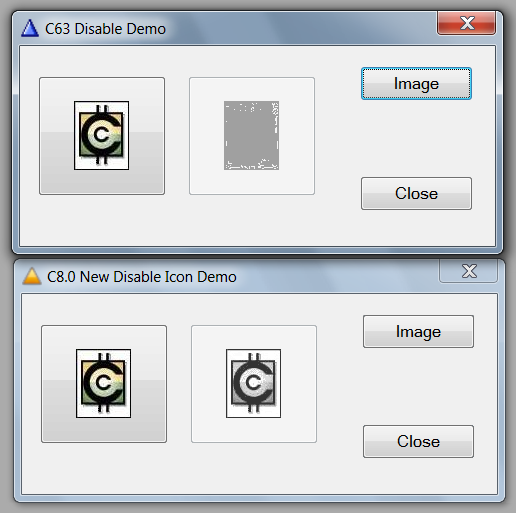
As you can see lots of nice UI improvements for your end users.
Clarion 7.3 Released
Tonight we released to the public Clarion 7.3 and the related add-on drivers (IMDD, DFD, and IPD)
First and foremost, a heartfelt thanks goes out to all of our 3rd Party Developers and Vendors, who helped to make this release the absolute best that it can be. We simply could not have done it without you!
At first glance, the read me file contains close to 140 fixes and enhancements since the last Clarion 7.2 release.
We at SoftVelocity know that you will enjoy using this latest update of Clarion, but get ready as there is no rest here at the home office as the next line of great development products are coming very soon. Expect another announcement in the next couple of days regarding the early pre-release of Clarion 8.
Also, the updated Examples install will be updated and is scheduled to go out on Monday.
On behalf of the entire SV staff, have a great weekend!
Happy Holidays from SoftVelocity
From all of us at SoftVelocity, we would like to take this opportunity to wish you and your families a very Merry Christmas and a Happy and Prosperous New Year.
Here is our Holiday hours of operation for the next few days:
12/24 – Closed at Noon (EST)
12/25 – 12/27 – Closed
12/28-12/30 – Open for business, normal hours.
12/31 – Closed
Of course, our support newsgroups are always open 24/7, and you can always purchase our products online anytime at http://www.softvelocity.com
A more detailed blog on Clarion versions 7.3, 8 (Beta), and Clarion.NET will follow here very soon.
All the best! We appreciate your business and support, and thank you!
Clarion 7.3 pre-release
Today we issued a pre-release of version 7.3 to 3rd party vendors, and in addition to a good number of fixes and improvements in both RTL and IDE, there is another noteworthy change. The convention for naming of Clarion DLLs and Libs has always been “C” plus the major version number, so we have C60Run.dll, C70Run.dll, and so on. The reasoning behind this came from the earliest release of Clarion for Windows, at a time when the internals of both RTL and File drivers were changing quite frequently. And in order to ensure that programs didn’t crash because of these internal changes, there was versioning code that diligently checked the version number of the RTL used in any binary against the currently loaded RTL. This version checking very often required you to do a complete rebuild of all your binaries even when no internals in the RTL or Drivers (or Compiler) had changed to require it, except for the external version number.
Now in Clarion 7.3 we’ve made some changes for the better. The visible change is that in Version 7.3 the naming convention used for Clarion DLLs and LIBs is no longer version specific. Now in 7.3 we use a prefix of “CLA” for all our binaries. For example:
C70RUN.DLL is now CLARUN.DLL
C70RUNL.LIB is now CLARUNL.LIB
C70TPS.DLL is now CLATPS.DLL
And so on.
But the changes you can’t see are where the benefits can be found. In continuing to reduce the lines between product releases, our version checking code has had a makeover. Now we maintain an internal version for the RTL that is separate from the external visible version number, and assuming that no changes to internal structures accessible from the outside world have been made, and the RTL internal number hasn’t been incremented, then rebuilding of binaries won’t be required.
That means, for example, the following:
If a user has his Exe plus 20 Dlls built with 7.3.7852 and a few weeks later we release 7.3.8011 – and it has some fix he needs, he can just copy the 7.3.8001 RTL and drivers into his app folder and run his app without a rebuild of his binaries. We see huge benefits in productivity ahead with this change.
For the project settings of your .Apps, the change is seamless – you don’t have to take any action for items the templates have added to the project. If you use the macro expansion symbols those are also updated to return the new naming convention.
Of course if a rebuild of binaries is needed, a message (not an error) will be displayed, or if the incorrect RTL is used it will also just show a message alerting the user about the use of the incorrect version.
Along with this version change the SYSTEM properties; PROP:ExeVersion and the PROP:LibVersion are also changed and extended, see the Help file for details.
Thanksgiving Holiday
This week we have been working hard on the final testing and closedown of Clarion 7.3, and much more. With Thanksgiving tomorrow, it’s time to take a little break to reflect on the many things that we have to be thankful for, most important customers like you!
Our office will be closed from 11/25 thru 11/28 for the Thanksgiving Holiday, and will reopen on Monday, November 29th.
From all of us at SoftVelocity, have a safe and restful holiday weekend, and the very best wishes from our families to yours!
Upcoming releases and news from Denver
The Clarion User conference was a great success. I presented the keynote remotely, and in this post I’ll cover the highlights of the presentation.
First on the Clarion for Windows Win32 side – I mentioned that the next release for Clarion 7 will be version 7.3, and in that release we’ll deliver several key RTL bug fixes and additional fixes for ReportWriter and the IDE. The 7.3 release will be ready to go out around mid-month. I also did a brief demo of Clarion8, I only touched upon some of the new features already implemented, such as the new “edit as text” mode for the Data pad, and the new locators added to every list in the Dictionary editor (and added to the Data pad as well). I also announced that we’ll be making an early access release for Clarion8 available to everyone with a subscription, and that will be ready by the end of this month.
On the .Net side I showed a short preview of the .Net Application Generator UI, and Pierre did further demonstrations during the conference. I explained that we are busy writing the .Net templates – and that the process of writing and testing the templates leads to bug fixes in the code generation engine. With lots of hard work, and a bit of luck, we hope you’ll see a beta release in December. I also mentioned that we’ll be putting all the templates (.Net and Win32) into a repository that will be open to the community. Doing this will allow Clarion developers instant access to the latest templates, and any template fixes or changes, and it will also allow Clarion developers to contribute their own templates and to participate in extending and refining existing templates. Later this week I’ll post another blog with some screenshots of the AppGen.Net UI – and as always we look forward to your feedback.
Update for 7.2
We just released another update for 7.2 with a nice mix of fixes and changes to both the IDE and the RTL.
You can check the readme list here
Update for 7.2
We just released an update for 7.2 with a nice mix of fixes and changes to both the IDE and the RTL. If you are a template writer then note that we’ve bumped the template version number to 7.2/7200.
You can check the readme list here